
Most people arrive at a stone showroom knowing what they want it to look like and having no idea what they want it to be made of. 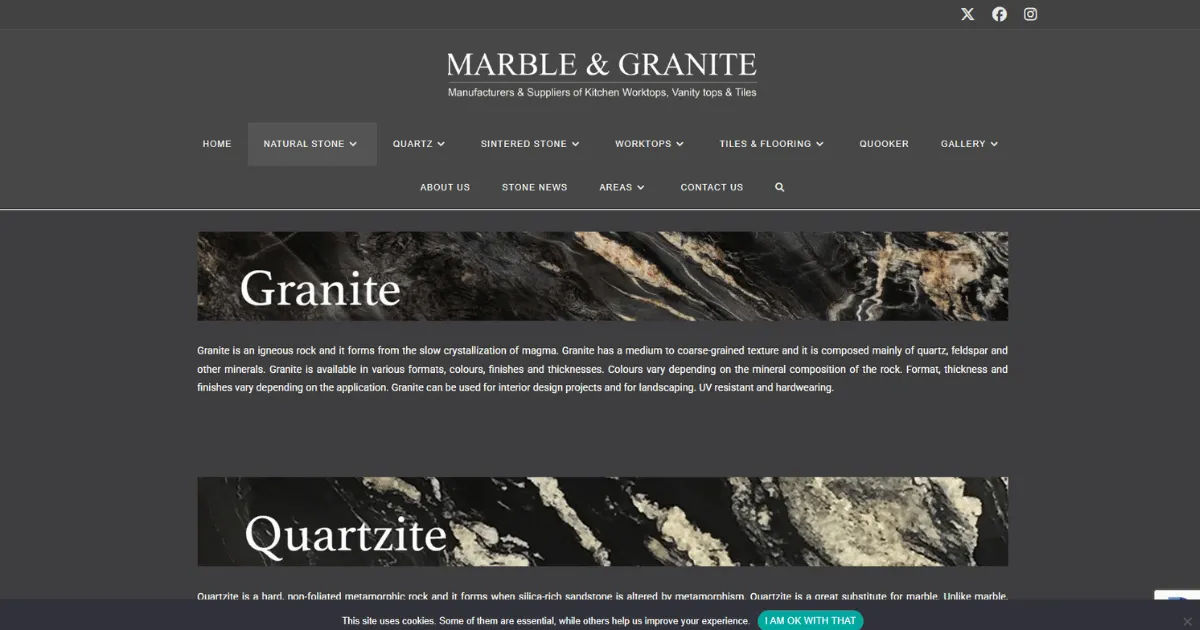 That is entirely reasonable. The four main surface families all produce beautiful worktops, and from across a room they can look remarkably similar.
The differences show up in how they behave over ten years in a working kitchen. Here is an honest comparison, written for anyone weighing up their options in Hatfield and the surrounding parts of Hertfordshire.
Marble
What it is. A metamorphic natural stone, formed from limestone under heat and pressure. Every slab is unique and no two are the same.
Why people choose it. Nothing else looks like it. The veining in a Calacatta, a Statuario or an Arabescato has a depth that manufactured surfaces approximate but do not reproduce. It also stays cool, which is why pastry chefs have always liked it.
What you need to accept. Marble is calcium carbonate, which means it reacts with acid. Lemon juice, vinegar, wine and tomato will etch the surface, leaving a dull mark where the polish has been chemically removed. It is also relatively soft and porous, so it stains if a spill sits.
Who it suits. People who understand that marble develops a patina and consider that part of its character. A honed finish rather than a polished one disguises etching far better, and darker marbles are more forgiving than white ones.
Granite
What it is. An igneous stone, formed from cooled magma, made up of interlocking quartz, feldspar and mica crystals.
Why people choose it. Hardness. Granite is significantly harder than marble, highly heat resistant, and it does not etch from acid the way marble does. Sealed properly, it handles a busy family kitchen without complaint.
What you need to accept. It is porous, so it needs sealing on installation and periodically afterwards. The look is granular and speckled rather than veined, which some people love and others find dated, though the newer exotic granites are a long way from the mid-1990s speckled black everyone pictures.
Who it suits. Households that want a natural stone but do not want to think about it much.
Quartz
What it is. An engineered surface, typically around ninety per cent crushed natural quartz bound with resin and pigment.
Why people choose it. Consistency and practicality. Because it is manufactured, the slab you see in a brochure is the slab you get, which makes planning far easier. It is non-porous, so it never needs sealing, and it resists staining well.
What you need to accept. The resin content means it is not as heat resistant as natural stone. A pan straight off the hob can scorch it. Prolonged direct sunlight can also affect some quartz over years, which matters for a worktop running past a large south-facing window or continuing outside.
Who it suits. Most family kitchens, honestly. It is the pragmatic choice and the range now covers everything from convincing marble veining to plain concrete tones.
Sintered stone
What it is. The newest category. Natural minerals compacted under enormous pressure and fired at very high temperature, producing a surface with no resin content at all.
Why people choose it. It is the most technically capable surface available. Extremely hard, effectively non-porous, resistant to heat, resistant to staining, and UV stable so it can be used outdoors and in bright rooms without fading. It also comes in large format slabs, which means fewer joints on a long run or a big island.
What you need to accept. Fabrication is more demanding, so it costs more to work than quartz, and it must be cut and handled by people who know it. The very hard, thin slabs can chip on an unsupported edge if mishandled.
Who it suits. Anyone specifying an island with a waterfall edge, an outdoor kitchen, a full-height splashback, or a kitchen with a great deal of glazing.
A quick comparison
- Heat resistance: excellent for granite and sintered stone, good for marble, moderate for quartz
- Acid and etching: excellent for sintered stone, good for granite and quartz, poor for marble
- Stain resistance: excellent for sintered stone, very good for quartz, good for granite once sealed, poor for marble
- UV stability: excellent for sintered stone, good for marble and granite, variable for quartz
- Sealing required: yes for marble and granite, no for quartz and sintered stone
- Every slab unique: yes for marble and granite, no for quartz and sintered stone
The questions that actually decide it
Rather than starting with the material, start with these.
Who cooks, and how? A household that cooks seriously and puts hot pans down without thinking should not be sold a resin-based surface without that being explained.
How much light does the room get? A wall of bi-fold doors changes the UV question entirely.
Is there an island, and how big? Slab dimensions determine whether you get a joint. Sintered stone and some quartz come in larger formats.
Do you want it to age, or stay as it is? This is the marble question, and it is a temperament question rather than a technical one.
Is any of it going outside? That narrows the list quickly.
What edge detail do you want? A mitred edge that makes a 20mm slab read as 60mm is a fabrication decision with a real cost, and it changes the whole look.
Seeing full slabs matters more than samples
A 100mm sample tells you the colour. It tells you nothing about the movement in the stone, where the veining runs, or how a slab will look once it is cut into a worktop and an island.
For natural stone in particular, viewing the actual slabs and agreeing which sections go where is the difference between a good result and a great one. Book matching, where two slabs are opened like a book so the veining mirrors, only works if the selection is done deliberately at the slab stage.
Our natural stone range sets out the marble, granite, quartzite, limestone and sandstone we hold, and the showroom is set up so full slabs and finished pieces can be seen together.
Local, and worth visiting in person
Marble & Granite Ltd has been fabricating and installing stone since 2006, working across Hertfordshire on everything from single kitchens to large residential and commercial projects.
If you are looking for a marble and granite centre in Hatfield, the showroom is at 136-138 Great North Road, Birchwood Industrial Estate, Hatfield AL9 5JN, open Monday to Friday from 8am to 5pm and Saturday from 10am to 4pm for showroom visits. You can call 01992 535 038 to arrange a slab viewing.