
In today’s online world, businesses need more than a website and a social media page to reach potential customers. They need a clear strategy for attracting people, building trust, and turning visitors into customers. A digital marketing agency helps businesses achieve these goals by planning, managing, and improving online marketing activities.
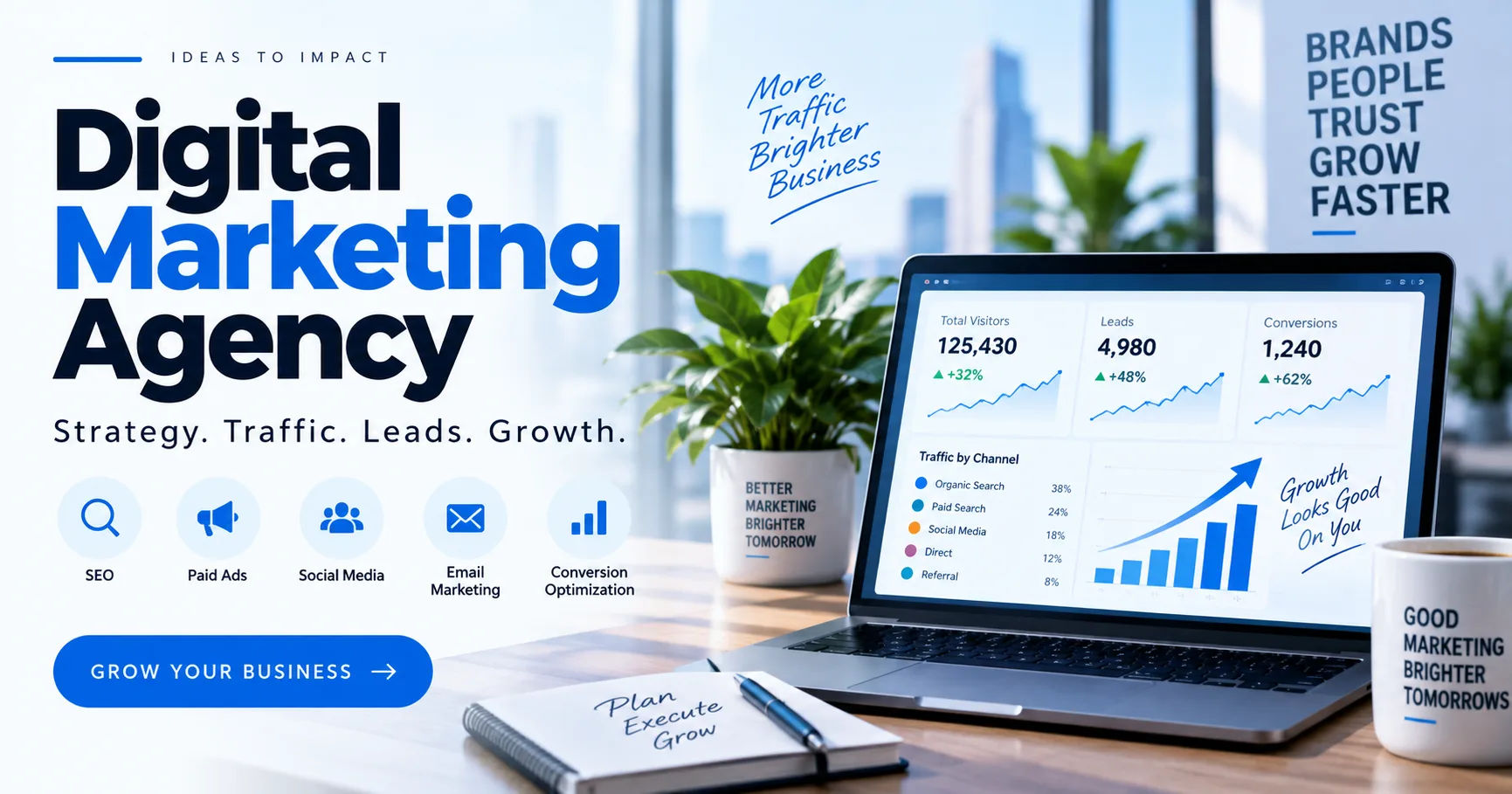
These agencies can handle areas such as search engine optimization, social media, paid advertising, content creation, email marketing, website optimization, and analytics.Whether a company is new or already established, digital marketing can play an important role in its growth. Instead of managing every online marketing task internally, a business can work with specialists who understand different digital channels and how they work together.
Digital Marketing Agencies
A digital marketing agency is a company that provides online marketing services to businesses, organizations, and individuals. Its main purpose is to help clients connect with their target audience through digital platforms.
Traditional marketing may include newspapers, billboards, television, radio, and printed materials. Digital marketing focuses on channels that people use online, including search engines, websites, social media platforms, email, and digital advertising networks.
The exact services offered can vary from one agency to another. Some agencies provide a complete range of services, while others specialize in one area, such as SEO, paid advertising, or social media marketing.
What Are the Main Responsibilities?
The responsibilities of a digital marketing agency depend on the needs of its client. A small business may need help building an online presence, while a larger company may need ongoing campaigns across several platforms.
An agency usually begins by understanding the business, its audience, competitors, products, services, and goals. It then creates a marketing strategy designed around those factors.
After the strategy is established, the agency may create content, manage campaigns, optimize websites, monitor performance, and make adjustments based on the results.
Developing a Digital Marketing Strategy
A strong strategy gives marketing activities a clear direction. An agency may begin by identifying the company's target customers and understanding what those customers search for, what problems they have, and what influences their purchasing decisions.
The agency can then select suitable marketing channels. For example, a local business may benefit from local SEO and social media, while an online store may focus heavily on search engine optimization, product advertising, email marketing, and social campaigns.
A strategy also establishes goals. These might include increasing website traffic, generating leads, improving online visibility, increasing sales, or building brand awareness.
Search Engine Optimization
Search engine optimization, commonly known as SEO, is one of the most important services provided by many agencies.
SEO involves improving a website so that search engines can better understand its content and users can find it more easily through relevant searches.
An agency may research keywords, improve website content, optimize page titles and descriptions, improve internal linking, identify technical problems, and develop useful content.
SEO is generally a long-term process. Results can take time because search visibility depends on many factors, including competition, website quality, content relevance, technical performance, and authority.
Content Marketing
Content helps businesses communicate with their audience. A digital marketing agency may develop blog posts, articles, website pages, guides, videos, social media posts, infographics, or other forms of content.
Good content should provide something useful to the audience rather than simply promoting a product.
For example, a company selling home appliances could publish guides about choosing energy-efficient appliances, maintaining equipment, and solving common problems.
This type of content can help answer customer questions while also creating opportunities for the business to appear in search results.
Social Media Marketing
Social media allows businesses to communicate directly with potential and existing customers.
An agency may manage platforms such as Facebook, Instagram, LinkedIn, TikTok, or other networks depending on where the target audience spends time.
Social media responsibilities can include developing content calendars, writing captions, creating visual concepts, scheduling posts, responding to comments, monitoring engagement, and analyzing performance.
The goal is not always to make every post go viral. A successful social media strategy should support the broader business objectives.
Pay-Per-Click Advertising
Paid advertising is another major area of digital marketing. Pay-per-click, or PPC, campaigns allow businesses to pay for advertisements displayed on search engines, social platforms, websites, and other digital channels.
A digital marketing agency can research keywords, create advertisements, define target audiences, establish budgets, and monitor campaign performance.
For example, a company offering emergency plumbing services may use paid search advertising to reach people who are actively searching for plumbing assistance.
Agencies can also test different advertisements and landing pages to determine which combinations generate better results.
Email Marketing
Email remains a useful communication channel for many businesses.
An agency may help create email campaigns for newsletters, promotions, product announcements, customer education, and follow-up communication.
Email marketing can also involve segmentation. Instead of sending exactly the same message to everyone, businesses can organize subscribers according to interests, previous purchases, location, or other relevant information.
Personalized and useful communication can help businesses maintain relationships with existing customers.
Website Optimization and Conversion
Getting visitors to a website is only part of digital marketing. Businesses also need to make it easy for visitors to take the desired action.
This is where conversion optimization becomes important.
An agency may examine website navigation, page layouts, calls to action, forms, product pages, checkout processes, and mobile usability.
For example, if many people visit a product page but very few purchase the product, the agency may investigate possible reasons. The page could have unclear information, a complicated checkout process, slow loading times, or an ineffective call to action.
Improving these elements can help a business get more value from its existing website traffic.
Online Reputation Management
A company's online reputation can influence how potential customers perceive it.
People may read reviews, look at social media profiles, search for customer experiences, and compare several businesses before making a decision.
Some agencies help businesses monitor online mentions and respond appropriately to customer feedback.
Reputation management does not mean removing every negative comment. Instead, it can involve identifying recurring problems, responding professionally, encouraging genuine customer feedback, and improving communication.
Data and Analytics
One major advantage of digital marketing is the amount of information that can be measured.
A digital marketing agency may use analytics tools to study website traffic, advertising performance, conversions, customer behavior, and other metrics.
For example, an agency can examine which pages attract visitors, where visitors come from, how long they stay, and whether they complete important actions.
This information helps marketers make informed adjustments instead of relying entirely on assumptions.
Important Marketing Metrics
Different businesses need different measurements. Common metrics include website traffic, impressions, click-through rates, conversion rates, leads, customer acquisition costs, sales, and return on advertising spending.
It is important to understand that a high number in one metric does not automatically mean a campaign is successful.
For example, a website may receive thousands of visitors but generate very few leads. In that situation, the business may need to examine audience quality, content, offers, or conversion processes.
Competitor Research
Understanding competitors can help a business identify opportunities and potential challenges.
An agency may research competitors' websites, search visibility, advertising strategies, social media activity, content, and customer positioning.
The purpose is not simply to copy another business. Instead, competitor research can help identify gaps in the market and areas where a company can provide something different or more useful.
For example, if competing websites provide basic information about a service but fail to answer common customer questions, a business could create more detailed and helpful resources.
Local Digital Marketing
Local businesses often need strategies that focus on customers in a specific geographic area.
Restaurants, clinics, repair companies, salons, real estate businesses, and local stores can benefit from local digital marketing.
A digital marketing agency may optimize local business profiles, create location-focused content, improve local search visibility, and help businesses maintain consistent contact information online.
Reviews can also be important for local businesses because potential customers often consider other people's experiences before choosing a nearby service provider.
Who Can Benefit From an Agency?
Businesses of many sizes can use digital marketing services.
Small businesses may hire an agency because they do not have an internal marketing team. Working with external specialists can provide access to skills that would otherwise require several employees.
Growing companies may use agencies to expand their marketing campaigns or enter new markets.
Larger organizations may work with agencies for specialized projects, additional campaign support, technical SEO, paid advertising, content production, or strategic planning.
The right approach depends on the company's budget, goals, internal skills, and workload.
How Does an Agency Work With a Client?
The relationship usually begins with a discovery process.
The agency learns about the business, its products or services, target audience, competitors, current marketing activities, and objectives.
The next stage may involve an audit. The agency examines the existing website, search presence, social media accounts, advertising campaigns, content, and other relevant areas.
Based on the findings, the agency develops a strategy and establishes priorities.
After implementation begins, performance is monitored regularly. Campaigns may be adjusted according to the data and changing business conditions.
Communication is also important. Clients should understand what work is being performed, why it matters, and what the available results indicate.
Benefits of Hiring a Digital Marketing Agency
One benefit is access to specialized knowledge. Digital marketing includes many disciplines, and keeping up with changes across all of them can be difficult for a small internal team.
Another benefit is time savings. Business owners and employees can focus on operations while marketing specialists manage specific online activities.
Agencies can also provide structured processes. Instead of posting randomly or running advertisements without a clear objective, businesses can follow a planned strategy.
However, hiring an agency does not guarantee immediate success. Marketing results depend on factors such as the industry, competition, budget, product quality, target audience, website experience, and consistency.
How to Choose the Right Agency
Businesses should look beyond attractive promises when evaluating an agency.
First, consider whether the agency has experience relevant to the business's industry or marketing goals.
Next, ask about its services and methods. A reputable agency should be able to explain what it plans to do and how performance will be measured.
Communication is another important factor. Clients should know who will manage their account, how often they will receive updates, and how questions will be handled.
Businesses should also understand pricing before beginning a project. Different agencies may charge monthly retainers, project-based fees, hourly rates, or other arrangements.
Finally, businesses should be cautious about promises of guaranteed rankings, guaranteed sales, or instant results. Digital marketing involves variables that no agency can completely control.
Common Misunderstandings About Digital Marketing Agencies
One common misunderstanding is that an agency only creates social media posts. In reality, agencies can handle many different areas, including SEO, advertising, content, analytics, email marketing, and website optimization.
Another misconception is that digital marketing produces instant results. Some paid campaigns can generate traffic quickly, but SEO, content marketing, reputation building, and brand development often require consistent effort over time.
It is also incorrect to assume that more traffic always means more success. The quality of the audience matters. A business needs visitors who are relevant to its products or services.
The Future of Digital Marketing
Digital marketing continues to evolve as technology and consumer behavior change.
Artificial intelligence, automation, personalization, short-form video, voice search, analytics, and new advertising technologies are influencing how businesses communicate online.
At the same time, basic principles remain important. Businesses still need to understand their customers, provide useful information, communicate clearly, and create experiences that make it easy for people to take action.
Agencies that adapt to new technologies while maintaining these fundamentals can help businesses respond to changing customer expectations.
Conclusion
A digital marketing agency helps businesses build and manage their presence across online channels. Its work can include strategy development, SEO, content marketing, social media, paid advertising, email campaigns, website optimization, reputation management, competitor research, and analytics.
The exact role of an agency depends on the client's needs. Some businesses may need help with one specific service, while others may require a complete digital marketing strategy.
The most effective approach begins with clear business goals and a good understanding of the target audience. Marketing activities should then be selected according to those goals and measured using meaningful performance indicators.
For businesses that want to grow online, working with experienced marketing professionals can provide access to specialized skills, structured strategies, and ongoing campaign management. However, choosing an agency should involve careful consideration of its experience, communication, services, methods, pricing, and approach to measuring results.
Ultimately, digital marketing is not simply about being visible online. It is about reaching the right people, providing useful information, building trust, and creating a clear path from awareness to customer action. When these elements work together, online marketing can become a valuable part of a business's overall growth strategy.