
Choosing between a hot plate and an electric stove can seem simple until you consider how each appliance heats food, how much space it needs, how much electricity it consumes, and what kind of cooking you actually do. Both appliances use electricity to produce heat, but their design, capacity, controls, and everyday convenience can be quite different. 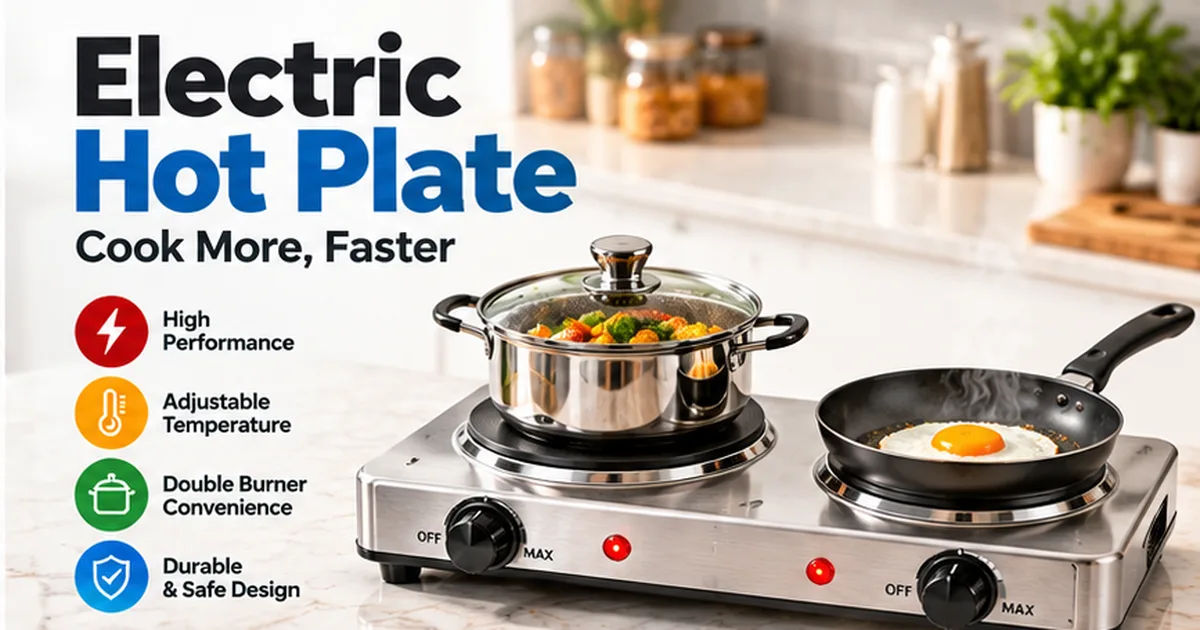 For students, renters, small families, office kitchens, hostels, and people setting up a temporary cooking area, a hot plate can be a practical option.
A full electric stove, on the other hand, is designed more like a permanent cooking appliance and usually offers several cooking zones and a larger cooking surface.
The difference also matters when you are comparing the hot plate price in Pakistan with the cost of purchasing and installing a complete electric stove. A cheaper appliance is not automatically the better choice because the right option depends on cooking habits, available space, cookware, electricity supply, and how often the appliance will be used.
Understanding the differences before buying can help you avoid spending money on features you do not need.
What Is a Hot Plate?
A hot plate is a compact electric cooking appliance with one or more heating surfaces. It is generally designed to sit on a countertop, table, kitchen shelf, or another suitable heat-resistant surface.
The heating element underneath the cooking surface becomes hot when electricity passes through it. You then place a suitable pot, pan, kettle, or other cookware on the heated area.
Traditional hot plates commonly use exposed or covered coil heating elements. Some modern versions use smooth ceramic or glass surfaces. There are also induction hot plates, which work differently by creating an electromagnetic field that directly heats compatible cookware.
The biggest advantage of a hot plate is its simplicity. It does not require a full kitchen installation. You normally plug it into an appropriate electrical outlet and use it as a separate cooking station.
This makes it useful when space is limited.
What Is an Electric Stove?
An electric stove is a larger cooking appliance designed for regular kitchen use. Depending on the model, it may have two, three, four, or more cooking zones.
Many electric stoves are integrated into a kitchen counter or combined with an oven. Freestanding electric ranges may include both a cooktop and an oven in one appliance.
Electric stoves can use several heating technologies. Conventional models may use metal heating coils, while newer models often use smooth radiant glass or ceramic cooktops. Induction cooktops are another category and use magnetic fields to heat compatible cookware.
Because an electric stove is designed for a full kitchen, it usually provides greater cooking capacity than a single hot plate.
Hot Plate vs Electric Stove: The Basic Difference
The easiest way to understand the difference is to think about purpose.
A hot plate is generally a portable cooking appliance. An electric stove is generally a larger, more permanent cooking appliance.
A hot plate may have one heating zone, although double hot plates are also widely available. An electric stove normally has multiple zones and may include an oven.
Hot plates are often chosen for limited-space cooking, temporary kitchens, supplementary cooking, or occasional use. Electric stoves are more suitable for households that regularly prepare multiple dishes at the same time.
This difference naturally affects the hot plate price in Pakistan because compact appliances generally have fewer components and lower capacity than complete electric cooking systems.
Difference in Size and Portability
Size is one of the most obvious differences.
A typical hot plate is small enough to move from one location to another. You can store it in a cabinet when it is not needed, although it should be allowed to cool completely before handling or storing it.
This portability can be particularly useful in small apartments, hostels, guest rooms where cooking is permitted, offices, or temporary accommodation.
An electric stove requires considerably more space. A conventional full-size stove may occupy a dedicated section of the kitchen and can be difficult to move frequently.
If you live somewhere with limited counter space, the compact design of a hot plate can be a major advantage.
Difference in Cooking Capacity
Cooking capacity is where an electric stove usually has a clear practical advantage.
With a full electric stove, you may be able to use several cooking zones at the same time. For example, you could heat curry on one burner, boil rice on another, and prepare vegetables on a third.
A single hot plate limits you to one main cooking surface.
A double hot plate provides more flexibility, but it still does not necessarily offer the same surface area, power distribution, or cooking capacity as a full-size electric stove.
If you usually cook elaborate meals with several pots, a full electric stove may fit your routine better.
If you mostly boil water, prepare tea, heat food, cook eggs, make noodles, or prepare small meals, a hot plate may provide enough capacity.
Difference in Heating Technology
Not every hot plate and electric stove works in exactly the same way.
Traditional Electric Heating
Traditional appliances use electrical resistance heating. Electricity passes through a resistive heating element, which becomes hot.
The heat then transfers to the cookware and eventually to the food.
This technology is straightforward and works with many types of cookware.
However, the heating element and cooking surface can remain hot for some time after the power has been switched off. This means users need to pay attention to residual heat.
Ceramic and Glass Cooktops
Some electric stoves and hot plates have smooth ceramic or glass surfaces.
These are easier to wipe clean because there are fewer exposed parts where food can collect.
They can also have a modern appearance.
However, smooth surfaces require appropriate cookware and careful handling. Heavy objects should not be dropped onto them because the surface can potentially crack or become damaged.
Induction Technology
Induction cooking is different from conventional electric heating.
Instead of simply heating a resistance element and transferring that heat into a pan, an induction system generates a magnetic field that interacts with compatible cookware.
This can produce very fast heating and precise temperature control.
The important limitation is cookware compatibility. Many induction appliances require magnetic cookware, such as certain cast-iron or magnetic stainless-steel pans.
Therefore, someone comparing a hot plate with an induction electric stove should not assume they work in exactly the same way.
Which One Is More Energy Efficient?
Energy efficiency depends heavily on the technology and how the appliance is used.
A traditional resistance hot plate converts electrical energy into heat, but some heat can be lost around the cookware and cooking surface.
Induction systems can transfer energy to compatible cookware more directly and are generally recognized for efficient cooking.
However, the overall electricity cost depends on more than the appliance's headline wattage.
Cooking duration matters.
The amount of food being prepared matters.
The cookware matters.
Your cooking habits matter too.
For example, running a high-powered appliance for a short period may not necessarily consume more electricity than using a lower-powered appliance for a much longer period.
When considering the hot plate price in Pakistan, it is therefore useful to think beyond the initial purchase price and consider expected electricity use over the appliance's lifetime.
Which One Is Better for Small Kitchens?
For a small kitchen, a hot plate can be particularly convenient.
It occupies much less space and does not necessarily require permanent installation. After cooking, you can move it or store it, provided the appliance has cooled and is stored safely.
This flexibility is difficult to achieve with a full electric stove.
A compact kitchen may not need four cooking zones. If you normally prepare simple meals, paying for a large appliance may provide little practical benefit.
On the other hand, a small kitchen used by a family that cooks several dishes at once may still benefit from a full electric stove.
The right choice depends on how the available space is used rather than simply how small the kitchen is.
Which One Is Better for Families?
Families often need more cooking capacity.
When several people share meals, preparing food can involve multiple pots and pans. A full electric stove can make this easier because multiple cooking zones can operate simultaneously.
A hot plate can still be useful as an additional cooking surface.
For example, if the main stove is occupied, a separate hot plate can be used to boil water or prepare another dish. In that situation, a hot plate is not necessarily competing with the electric stove. It is supporting it.
This is one reason some households keep a portable cooking appliance even when they already have a complete kitchen stove.
Comparing Cost and Value
The purchase price is an important consideration, but it should not be the only factor.
The hot plate price in Pakistan can vary considerably depending on the number of heating zones, wattage, heating technology, controls, materials, safety features, and manufacturer.
A basic single-zone model is naturally different from a premium induction unit.
Similarly, electric stove prices vary according to size, cooking technology, number of zones, installation requirements, oven availability, and additional features.
Instead of asking only how much the appliance costs, ask what you are getting for that money.
A low-cost hot plate may be perfectly adequate for occasional cooking. A more expensive induction model may make sense for someone who cooks every day and values fast heating and precise control.
The hot plate price in Pakistan should therefore be considered alongside expected usage rather than viewed as an isolated number.
Controls and Temperature Adjustment
Another difference is the type and sophistication of controls.
Basic hot plates may use simple rotary knobs with several heat settings. These controls are easy to understand and require little learning.
More advanced models may include digital displays, timers, touch controls, temperature settings, automatic shutoff, and other features.
Electric stoves can offer similar controls, sometimes across several cooking zones.
Digital controls can be convenient, but more features can also mean more components that may require maintenance if something goes wrong.
For someone who wants straightforward cooking, a simple control system may actually be preferable.
Cleaning and Maintenance
Cleaning is another practical consideration.
A simple hot plate can be relatively easy to maintain, particularly if the cooking surface is smooth.
Traditional coil-style designs may require more attention around the heating element because food particles can become trapped nearby.
Glass and ceramic surfaces are generally easier to wipe down, but spills should still be cleaned according to the manufacturer's instructions.
Electric stoves can also be easy to clean when they have smooth surfaces. However, a larger stove naturally gives you more surface area to clean.
The best appliance is not necessarily the one that looks easiest to clean in a photograph. Consider how you actually cook and how often spills occur in your kitchen.
Safety Considerations
Electrical cooking appliances require responsible use regardless of size.
Always place the appliance on a stable, heat-resistant surface when it is designed for countertop use.
Keep flammable materials away from the hot cooking area.
Do not cover ventilation openings if the appliance has them.
Avoid using damaged power cords or plugs.
Never leave an active cooking appliance unattended for extended periods, particularly when children are nearby.
Remember that a cooking surface may remain hot after the appliance has been switched off.
A hot plate is portable, but portability does not make it risk-free. In fact, its small size can sometimes encourage people to place it on unsuitable surfaces or move it while it is still hot.
Always follow the manufacturer's instructions regarding electrical load, cookware, cleaning, ventilation, and safe operation.
Hot Plate or Electric Stove for Students?
Students living in hostels, shared accommodation, or small rooms may prefer a compact hot plate when cooking appliances are permitted by the property or institution.
It can be convenient for basic meals without requiring a full kitchen setup.
However, students should check accommodation rules before using any heating appliance. Some hostels and rental properties restrict portable cooking equipment because of fire and electrical safety concerns.
A hot plate can also be useful for someone who moves frequently because it is easier to transport than a full-size stove.
Hot Plate or Electric Stove for Regular Home Cooking?
For regular home cooking, the answer depends on the number of people and cooking style.
Someone who prepares simple meals for one or two people may find a hot plate sufficient.
A larger household that regularly cooks several dishes at once may find a multi-zone electric stove more convenient.
There is also a middle ground. A household can use a full stove as the primary cooking appliance and keep a hot plate as a secondary option.
This arrangement can be useful during busy cooking sessions or when an additional heating surface is needed.
What Should You Check Before Buying a Hot Plate?
Before purchasing a hot plate, look at its power rating and the type of heating technology.
Check whether the cookware you already own is compatible, especially if you are considering induction.
Consider the physical dimensions because the appliance needs enough safe space around it.
Look at the controls and determine whether you prefer knobs or digital touch controls.
Safety features such as overheating protection and automatic shutoff can also be valuable, depending on the model.
The hot plate price in Pakistan should be compared across models with similar specifications. A cheaper product may not be a genuine bargain if it lacks features you consider essential.
At the same time, there is no reason to pay for advanced features you will never use.
What Should You Check Before Buying an Electric Stove?
For an electric stove, start with the number of cooking zones you actually need.
Then consider whether you want a cooktop only or a stove that includes an oven.
Check the electrical requirements before installation. Larger appliances may require electrical arrangements that differ from those used by small plug-in appliances.
Also consider the dimensions of your kitchen and the location of the electrical connection.
If you are replacing an existing stove, measuring the available space before purchasing is especially important.
A beautiful appliance that does not fit the kitchen is an expensive lesson.
Can a Hot Plate Replace an Electric Stove?
In some situations, yes.
For basic cooking, a good hot plate can perform many of the same fundamental tasks as a single cooking zone on an electric stove.
You can boil, simmer, fry, heat, and cook many everyday foods.
The major limitation is capacity.
A hot plate does not necessarily provide the same number of cooking zones, surface area, stability, or integrated oven functionality as a complete electric stove.
Therefore, it can replace a stove for some users but not necessarily for every household.
How the Hot Plate Price in Pakistan Should Influence Your Decision
Price matters, especially when setting up a kitchen on a budget.
However, it helps to divide the decision into three questions: what you can afford, what you need, and how often you will use the appliance.
If your cooking requirements are modest, spending substantially more on a large stove may not provide meaningful benefits.
If you cook every day for several people, choosing an appliance solely because the hot plate price in Pakistan is lower could lead to frustration later.
Think about the total value.
A compact appliance that meets your needs can be a sensible purchase. A larger appliance that saves time during daily cooking can also justify its higher cost.
The goal is not simply to find the lowest price. It is to find the appliance that matches your actual cooking requirements.
Frequently Asked Questions
Is a hot plate the same as an electric stove?
No. Both use electricity for cooking, but a hot plate is usually a smaller portable appliance, while an electric stove is generally a larger cooking system with multiple cooking zones and, in some cases, an integrated oven.
Can I use normal cookware on a hot plate?
It depends on the type of hot plate. Conventional electric hot plates generally work with a broad range of cookware. Induction hot plates require compatible magnetic cookware.
Does a hot plate use a lot of electricity?
Its electricity consumption depends on its wattage and how long it operates. A high-powered appliance used for a long period will consume more electricity than a lower-powered appliance used briefly.
Is an induction hot plate better than a traditional hot plate?
They work differently. Induction can provide fast heating and efficient energy transfer, but it requires compatible cookware. A traditional resistance hot plate is generally less restrictive regarding cookware.
Can I cook rice on a hot plate?
Yes. A hot plate can be used for rice if the cookware is suitable and the appliance provides enough heat. Cooking time and temperature control depend on the particular model.
Is a hot plate suitable for daily cooking?
It can be. Many people can prepare everyday meals on one, particularly when cooking for one or two people. However, households requiring several cooking zones may prefer a full electric stove.
Is a hot plate cheaper than an electric stove?
A basic hot plate is generally less expensive to purchase than a complete electric stove, but prices vary by technology and features. Comparing the hot plate price in Pakistan with an electric stove requires looking at models with similar intended uses.
Conclusion
The difference between a hot plate and an electric stove mainly comes down to size, capacity, portability, heating technology, installation, and intended use.
A hot plate is compact, portable, and convenient for limited-space or occasional cooking. It can also work as a useful secondary cooking surface in a larger kitchen.
An electric stove is designed for more extensive cooking. Multiple cooking zones make it practical for families and people who regularly prepare several dishes at once. Models with integrated ovens can provide an even more complete cooking solution.
Heating technology is also important. Traditional resistance hot plates are simple and broadly compatible with cookware, while induction models can offer fast and efficient cooking but require compatible pans. Electric stoves are available with several heating technologies as well.
Cost should be considered carefully. Looking only at the hot plate price in Pakistan does not tell you whether a particular appliance represents good value. Consider its power, construction, controls, safety features, cooking capacity, energy use, and expected frequency of use.
Ultimately, there is no single appliance that fits every kitchen. Someone who needs a compact solution for simple meals may have very different requirements from a family preparing several dishes every evening.
The smartest approach is to match the appliance to the way you actually cook. When portability and simplicity matter most, a hot plate can be highly practical. When cooking capacity and multiple simultaneous dishes are priorities, an electric stove may be more appropriate. Understanding these differences makes it easier to spend your money on the features that genuinely matter rather than simply choosing the largest or cheapest appliance available.