
When working with custom clothing manufacturers USA, quality control is not simply a final check performed after every garment has been sewn. Reliable manufacturers build quality into the production process from the first fabric inspection through cutting, sewing, finishing, packaging, and final inspection.This matters because custom clothing has more variables than standard ready-made apparel.
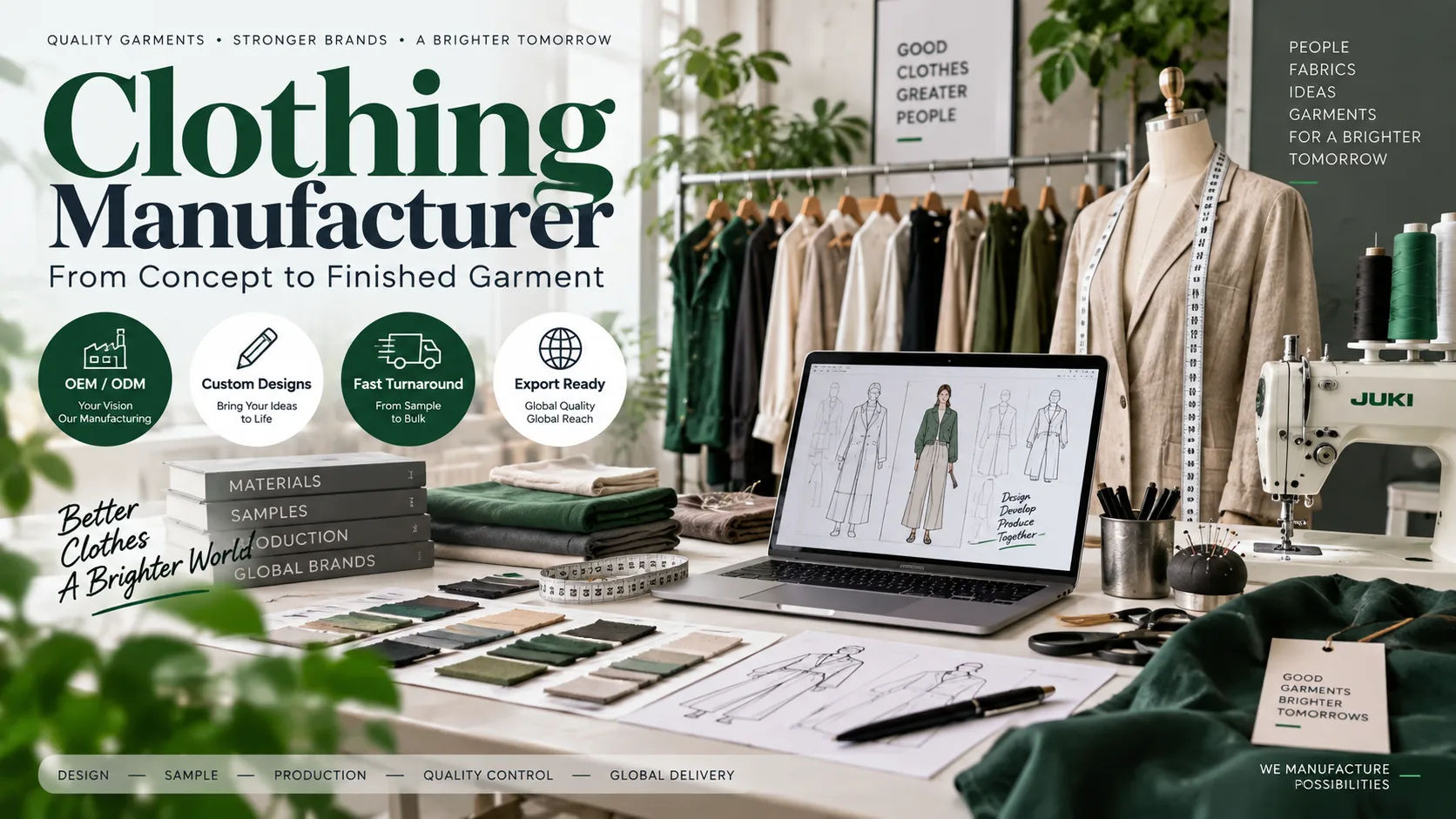
Custom clothing manufacturers USA may need a specific fabric weight, exact measurements, custom colors, special stitching, embroidery, printed artwork, labels, trims, and packaging. Every one of these details has to match the approved specifications.
A professional quality-control system therefore uses several checkpoints instead of relying on one inspection at the end. Industry guidance commonly identifies fabric and trim checks, in-line production inspections, measurement verification, workmanship checks, and final sampling as important parts of apparel quality control.
Why Quality Control Matters in Custom Clothing
Quality problems in clothing can be expensive.
A minor mistake discovered while a garment is still being sewn may take only a few minutes to correct. The same problem discovered after several hundred garments have been completed can require extensive rework or even replacement.
For a clothing brand, poor quality can also lead to customer complaints, returns, negative reviews, and lost repeat business.
This is why manufacturers try to identify problems as early as possible. Quality control is most effective when it prevents defects rather than simply identifying them after production is complete.
For custom clothing, the approved sample and technical specifications are especially important. They provide a physical and written reference for what the finished product should look and feel like.
What Happens Before Bulk Production?
Quality control begins before the factory starts producing the complete order.
The manufacturer normally reviews the technical specifications, patterns, measurements, fabric information, colors, artwork, trims, labels, and construction requirements.
A pre-production sample is then checked against these requirements.
Reviewing the Approved Sample
The approved sample becomes an important production reference.
Manufacturers compare bulk garments against the sample to make sure details such as collar shape, pocket placement, sleeve construction, stitching, proportions, and overall appearance remain consistent.
If the sample is changed during development, the updated version should be clearly documented. Otherwise, the factory may accidentally produce garments according to an older version.
Checking the Tech Pack
A detailed tech pack gives the production team measurable instructions.
It may include the fabric composition, fabric weight, measurements, seam construction, stitch requirements, artwork placement, labels, color references, and packaging instructions.
This is important because "make it high quality" is too vague to be a useful manufacturing specification.
A manufacturer needs measurable standards that inspectors can check consistently.
How Do They Check the Fabric?
Fabric is one of the first things inspected because problems in the material can affect an entire production run.
Before cutting, manufacturers may examine fabric for visible defects, incorrect color, inconsistent shade, holes, stains, weaving or knitting problems, and variations in weight or width. Depending on the product, shrinkage, colorfastness, stretch, and other performance characteristics may also be evaluated.
Fabric Weight and Composition
Fabric weight can affect how a garment feels, hangs, and performs.
For example, a lightweight cotton shirt should not suddenly become much heavier than the approved specification. Likewise, activewear may require a particular combination of stretch and recovery.
Manufacturers can compare incoming materials with the agreed specifications before those materials are cut into individual garment panels.
Color Consistency
Color variation can become obvious when garments are placed next to one another.
A manufacturer may compare fabric against an approved color standard or sample. Different dye lots can sometimes produce noticeable variations, so controlling shade consistency is particularly important for large orders.
For branded clothing, color accuracy also matters for logos, printed designs, embroidery, and trims.
How Is Cutting Quality Checked?
Cutting errors can create problems that become difficult to correct later.
Production teams check whether patterns and markers have been positioned correctly and whether the cut panels correspond to the required sizes and construction.
The direction of fabric can also matter. Some fabrics have a visible grain, nap, pattern, or texture that needs to run consistently across the garment.
Checking Panel Accuracy
Individual panels need to match the intended pattern.
If a front panel is cut incorrectly, for example, the problem can affect the garment's dimensions and appearance after sewing.
Manufacturers may also check notches and other construction markings that help sewing operators correctly assemble the garment.
Catching cutting mistakes early prevents the same error from being repeated across a large number of garments.
How Do They Check Stitching and Seams?
Stitching is one of the most important parts of garment inspection.
Inspectors look for skipped stitches, broken threads, loose seams, uneven stitching, excessive puckering, incorrect seam construction, and other workmanship problems.
A garment can look attractive from the outside while still having poor construction on the inside. That is why quality checks should include both visible and internal areas.
Checking Seam Strength
Seams need to withstand normal use.
Stress points such as armholes, crotches, pockets, waistbands, and areas around closures can receive additional attention because they experience repeated movement or tension.
The exact construction depends on the garment. A T-shirt, tailored jacket, hoodie, uniform, and pair of leggings will not necessarily use the same stitching methods.
Checking Stitch Consistency
Inspectors also look at whether stitching remains consistent throughout the garment.
Uneven stitch density, loose thread tension, skipped stitches, and visible irregularities can affect both appearance and durability.
Problems that occur repeatedly often indicate an issue with machine settings, operator technique, thread, fabric handling, or the production process.
How Are Measurements Checked?
A garment can be beautifully sewn and still be considered defective if its measurements are wrong.
This is why professional apparel quality control includes measurement checks against an approved specification.
Common measurements may include chest, waist, hip, shoulder, body length, sleeve length, inseam, rise, collar opening, and other points depending on the garment.
The manufacturer establishes acceptable tolerances rather than expecting every garment to have mathematically identical measurements.
For example, the specification might permit a small difference from the target measurement. The important point is that the tolerance should be agreed upon before production.
Checking Size Consistency
Manufacturers also need to make sure size grading is consistent.
A medium should not unexpectedly fit like a small, while an extra-large should not vary dramatically from the approved size chart.
Checking several sizes helps identify grading problems before the entire order reaches customers.
How Do They Check Custom Printing and Embroidery?
Custom clothing often includes artwork, logos, graphics, embroidery, patches, or other decorative elements.
These details require their own quality checks.
Inspectors can compare the finished decoration with the approved artwork for position, size, color, alignment, spelling, and overall appearance.
Print Quality
Printed designs should be checked for issues such as poor alignment, uneven coverage, cracking, incorrect colors, bleeding, or other visible defects.
The appropriate testing depends on the printing method and garment.
Embroidery Quality
Embroidery requires attention to thread tension, positioning, density, missing stitches, loose threads, and overall clarity.
Small errors can be surprisingly noticeable when a logo is placed on the chest, sleeve, cap, or another highly visible area.
How Are Zippers, Buttons, and Trims Checked?
Quality control also covers components attached to the garment.
Buttons should be secure. Zippers should operate correctly. Snaps, hooks, drawcords, buckles, patches, labels, and other trims should match the approved design and specification.
A garment can fail its quality expectations even when the fabric and sewing are excellent if the wrong zipper or label has been installed.
This is why component verification is part of a complete inspection rather than an afterthought.
What Is an In-Line Quality Inspection?
In-line inspection takes place while garments are still being produced.
Instead of waiting until the entire order is finished, quality personnel examine garments during cutting, sewing, and finishing.
This approach has an obvious advantage: recurring problems can be identified before hundreds or thousands of additional garments are affected.
For example, if inspectors discover that a pocket is consistently being positioned too low, production can be stopped and corrected before the mistake spreads throughout the order.
This is one of the biggest differences between a strong quality-control system and a factory that simply checks finished products.
What Is AQL Inspection?
AQL stands for Acceptable Quality Limit and is commonly used as a statistical sampling approach for finished apparel.
Instead of manually inspecting every garment in a large production run, inspectors randomly select a sample and evaluate it against predetermined defect criteria.
The sample size and acceptance criteria depend on the selected inspection plan and lot size. Common apparel quality frameworks distinguish between critical, major, and minor defects.
Critical, Major, and Minor Defects
A critical defect can involve safety or serious compliance concerns and may have zero tolerance.
A major defect can significantly affect appearance, function, fit, or saleability. Examples may include a significant measurement error, broken seam, obvious stain, or major printing problem.
A minor defect is generally a smaller imperfection that does not substantially affect the garment's function or usability.
The exact classification should be agreed upon between the buyer and manufacturer because different products can have different quality priorities.
AQL should also not be misunderstood as a promise that every individual garment will be perfect. It is a sampling system for evaluating a production lot.
How Is the Finished Garment Inspected?
Once production is substantially complete, the manufacturer can conduct a final inspection.
Inspectors may examine garments for measurements, fabric defects, stitching, appearance, labels, artwork, trims, finishing, quantity, and packaging.
They may also compare the garments against the approved sample and specifications.
Visual Inspection
The garment is examined for obvious problems.
This can include stains, holes, loose threads, crooked seams, uneven hems, mismatched panels, incorrect labels, or defective decorations.
Measurement Inspection
Selected garments are measured at predetermined points.
The results are compared with the approved measurement chart and tolerances.
Functional Inspection
Where appropriate, components are operated or tested.
Zippers are opened and closed. Buttons and snaps are checked. Stretch garments may be examined for recovery and seam behavior. Specialized garments may require additional performance tests.
How Is Packaging Checked?
Quality does not end when the garment passes inspection.
Manufacturers also need to verify that the correct garments are packed correctly.
This can include checking size and color assortment, labels, hangtags, folding, polybags, carton quantities, shipping marks, and other packaging instructions.
Incorrect packaging can create problems even when the garments themselves are manufactured correctly. Industry inspection guidance specifically includes packaging and carton information among common final inspection checks.
Can a Third Party Check Quality?
Yes.
Some brands use independent inspection companies to provide an additional quality check before shipment.
A third-party inspector can evaluate finished garments against the buyer's specifications and agreed inspection plan.
This can be particularly useful when the buyer is not physically present at the manufacturing facility.
However, third-party inspection should complement a manufacturer's internal quality-control system rather than replace it. The strongest approach is to prevent problems throughout production and use final inspection as another safeguard.
What Should Brands Ask Custom Clothing Manufacturers USA?
Before placing a large order, brands should ask how quality is controlled at each production stage.
Useful questions include whether the manufacturer provides pre-production samples, how fabric is inspected, when in-line inspections occur, how measurements are checked, how defects are classified, and whether final inspection reports are available.
It is also worth asking how the manufacturer handles failed inspections.
A quality system is much more valuable when the factory has a clear corrective-action process. If a recurring problem appears, the manufacturer should identify its cause, correct the production process, and verify that the problem has actually been resolved.
Why the Approved Sample Matters So Much
One of the easiest ways to create a quality dispute is to leave the production standard unclear.
An approved sample gives everyone a physical reference.
The buyer can say, in effect, "This is the garment we approved," while the factory can use the same reference when setting up production.
The sample should be supported by written specifications because a physical sample cannot communicate every requirement. Measurements, tolerances, fabric specifications, artwork files, labels, and packaging instructions should all be documented.
Common Quality Problems Manufacturers Try to Prevent
Some defects occur repeatedly across apparel production.
These include incorrect measurements, uneven stitching, skipped stitches, seam puckering, fabric stains, holes, shade variation, crooked prints, poor embroidery, incorrect labels, defective zippers, loose buttons, and packaging errors.
Many of these problems become easier to control when manufacturers inspect the production process instead of waiting until the end.
For example, finding an incorrectly positioned pocket during sewing is much easier to fix than discovering the same mistake after the entire order has been completed.
What Makes a Strong Quality-Control System?
The strongest systems combine several elements.
They start with clear specifications, an approved sample, and properly inspected materials. They continue with checks during cutting and sewing, followed by finished-garment inspection and final sampling.
Documentation is equally important.
Inspection results should be recorded so recurring problems can be identified and corrected rather than repeatedly discovered without understanding their cause.
Ultimately, quality control works best when the manufacturer and brand agree on what "acceptable quality" actually means before production begins.
Conclusion
So, how do custom clothing manufacturers USA check quality?
They typically use a combination of material inspections, pre-production approval, measurement checks, cutting controls, in-line inspections, stitching and workmanship checks, decoration verification, functional checks, final garment inspections, and sampling methods such as AQL.
The most important point is that quality should not be treated as one final inspection. Fabric problems need to be caught before cutting. Cutting errors need to be identified before sewing. Sewing problems need to be corrected while production is running. Finished garments then need another inspection before shipment.
For brands, the best protection is clear communication. An approved sample, detailed tech pack, measurement tolerances, fabric requirements, decoration specifications, packaging instructions, and agreed defect standards give the manufacturer something concrete to work toward.
A manufacturer that can explain its quality process clearly is also easier to evaluate. Instead of simply asking whether a factory makes "high-quality clothing," ask how quality is measured, when inspections happen, what happens when a defect is discovered, and how the finished order is approved.
That approach turns quality from a vague promise into a measurable part of the manufacturing process.