
Choosing a hosting business can seem complicated when you are just getting started. You may hear terms such as servers, bandwidth, control panels, domains, DNS, SSL certificates, and hosting accounts and wonder how they all fit together. Reseller hosting simplifies the business model because you do not need to own or operate your own physical server.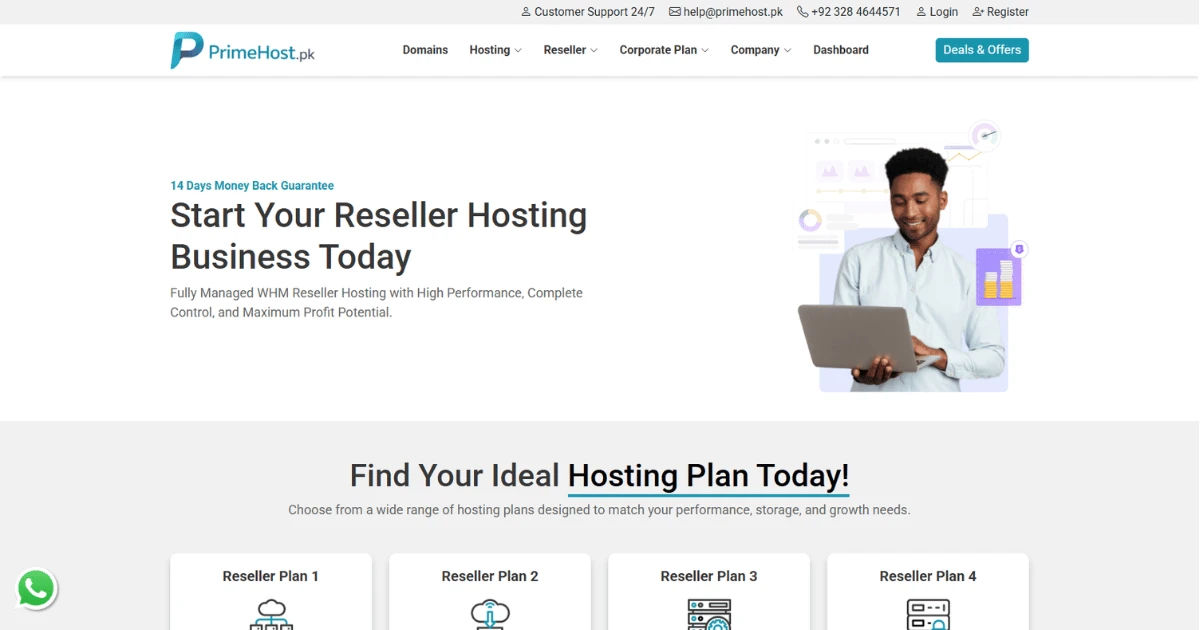
For beginners, cheap reseller hosting can provide an affordable way to enter the web-hosting market. Instead of purchasing expensive infrastructure, you rent server resources from an established hosting provider and divide those resources into smaller hosting accounts for your own customers.
The important point is that reseller hosting is not simply about buying a low-cost package and immediately selling hosting. You need to understand how resources are allocated, how customer accounts are created, how billing works, what support you are responsible for, and where the limitations of a low-priced plan can affect your business.
This guide explains how the model works from the ground up and what beginners should consider before choosing a reseller package.
What Is Reseller Hosting?
Reseller hosting is a hosting arrangement in which one hosting company provides server resources to another person or business, who then sells hosting services to individual customers.
Think of it like renting space in a commercial building and dividing that space into smaller offices. You do not own the building, but you can use the space and offer separate areas to your customers.
The hosting provider remains responsible for the underlying server infrastructure. Depending on the package, it may also handle server maintenance, operating-system updates, network management, hardware issues, and security at the server level.
As the reseller, you normally manage your customers and their hosting accounts.
This makes reseller hosting particularly attractive to web designers, developers, digital agencies, freelancers, and entrepreneurs who want to add hosting to their existing services.
How Cheap Reseller Hosting Works
The basic process is straightforward.
You purchase a reseller package from a hosting company. The package gives you a defined amount of resources, such as disk space, bandwidth, email accounts, databases, domains, and hosting accounts.
You then access a reseller control panel. Depending on the provider, this may include WHM or another management platform.
From there, you can create individual hosting accounts for customers.
Each customer receives their own hosting environment and control panel. They can usually install websites, create email addresses, manage databases, configure domains, and perform other standard hosting tasks.
You decide how much to charge your customers.
For example, suppose your reseller package costs $20 per month and allows you to create multiple hosting accounts. You might create a basic package for $5 per month and sell it to ten customers.
Your revenue would be $50 per month, while the hosting infrastructure costs remain tied to your reseller plan.
Of course, real profitability depends on the provider's limits, payment processing costs, taxes, customer support expenses, refunds, and the amount of resources your customers actually consume.
The Difference Between Reseller and Regular Shared Hosting
Understanding this difference is essential for beginners.
With ordinary shared hosting, you generally purchase hosting for your own websites. The hosting company controls the overall service, and you are treated as an end customer.
With reseller hosting, you are given tools to create and manage hosting accounts for other people.
Shared hosting is therefore mainly designed for website owners.
Reseller hosting is designed for someone who wants to manage multiple independent customers.
A reseller may have access to account-management tools that allow them to create packages, suspend accounts, modify resource limits, and manage multiple websites from one central interface.
What You Actually Buy
A common beginner mistake is to assume that you are buying a server.
Usually, you are not.
You are purchasing permission to use a portion of a hosting provider's infrastructure.
Your plan may include a certain amount of storage, bandwidth, CPU resources, RAM allocation, email functionality, databases, and account capacity.
The exact limits vary considerably between providers.
Some plans may advertise unlimited websites or bandwidth, but "unlimited" does not necessarily mean unlimited server resources. Providers can still impose acceptable-use policies and CPU, memory, inode, or process limitations.
Therefore, do not judge a package only by its headline storage or bandwidth figure.
The Role of the Control Panel
The control panel is one of the most important parts of reseller hosting.
For the reseller, a management panel such as WHM can provide tools for creating hosting packages and customer accounts.
You can define different plans based on storage, bandwidth, domains, email accounts, databases, and other features.
For example, you could create three packages:
-
Starter for small personal websites
-
Business for growing websites
-
Professional for customers needing more resources
Your customers may then use a separate control panel, such as cPanel, to manage their individual websites.
This separation makes the service look more professional than simply placing every customer's website inside one shared account.
How Customer Accounts Are Created
After purchasing a reseller plan, you normally configure your reseller account and establish your hosting packages.
You then create an account for each customer.
During account creation, you may enter the customer's domain name, username, password, package, email information, and other settings.
The server then provisions the account.
The customer can log in to their hosting control panel and manage their website.
This process can be manual when you have only a few customers. As your business grows, automation becomes increasingly useful.
Domain Names and DNS
Hosting and domain registration are related but separate services.
A domain is the address people use to visit a website.
Hosting provides the server space where the website files are stored.
For a customer to use your hosting service, their domain must point toward the appropriate hosting server.
This is usually handled through DNS settings.
Your hosting provider may give you nameservers that customers can use. For example, your reseller business might use branded nameservers associated with your domain.
When DNS is configured correctly, visitors entering the customer's domain are directed toward the appropriate hosting server.
DNS changes can take some time to propagate, so beginners should not assume that a newly configured domain will always work immediately.
Branding Your Hosting Business
One advantage of cheap reseller hosting is the possibility of creating your own brand.
Depending on the provider, you may be able to use your business name, logo, branded nameservers, customized customer-area information, and your own hosting packages.
This means customers may interact primarily with your business rather than directly with the infrastructure provider.
However, white-label options differ between companies.
Before purchasing a plan, check exactly which branding features are included.
Some inexpensive packages may provide basic reseller functionality without extensive white-label customization.
How Billing Works
Hosting providers generally charge you a fixed monthly or annual fee for your reseller package.
You then decide what your customers pay.
Billing can be handled manually at first. For a few customers, you might send invoices and activate accounts yourself.
As the number of customers increases, manual management becomes inefficient.
Hosting businesses often use billing and automation software to handle customer registration, invoices, recurring payments, account provisioning, suspensions, and service renewals.
Automation is especially useful because hosting is often a recurring subscription business.
Where the Profit Comes From
The reseller model works because you purchase hosting resources at one level and sell smaller hosting packages at another.
Imagine your reseller package costs $30 per month.
If you have fifteen customers paying an average of $6 per month, your monthly revenue is $90.
That leaves $60 before other business expenses.
However, this example should not be interpreted as guaranteed profit.
Customers use different amounts of resources. Some may generate significant traffic, while others may barely use their allocated storage.
You also need to consider payment fees, software subscriptions, advertising, domain costs, taxes, support time, refunds, and occasional technical problems.
The real goal should be sustainable margins rather than simply maximizing the number of accounts.
Why Beginners Consider Cheap Reseller Hosting
Cost is one of the biggest reasons beginners choose reseller hosting.
Starting a traditional hosting company with dedicated infrastructure can require significantly more technical knowledge and capital.
A low-cost reseller plan reduces the initial financial barrier.
You can experiment with your business model without immediately committing to expensive hardware or advanced infrastructure.
It can also be useful for learning.
You can gain practical experience with customer management, DNS, hosting accounts, website migrations, backups, email configuration, SSL certificates, and troubleshooting.
This experience can become valuable if you later move to VPS or dedicated infrastructure.
The Hidden Risks of Very Cheap Plans
Low prices can be attractive, but there is an important distinction between affordable and excessively cheap.
A provider offering a dramatically lower price may have limitations that are not obvious from the sales page.
Server performance is one concern.
If the underlying server is heavily overloaded, websites may become slow during busy periods.
Support quality is another issue.
When your customer has a technical problem, you may need to contact your provider. Slow or unhelpful support can directly affect your reputation.
Backups are also critical.
Never assume that a hosting provider's backup system automatically protects your business from every possible problem.
Find out how frequently backups are performed, how long they are retained, and whether customers can restore their own accounts.
Security Responsibilities
Reseller hosting does not remove every security responsibility from you.
The hosting company normally handles infrastructure-level security, but your customers' websites can still contain vulnerable plugins, outdated software, weak passwords, malicious scripts, or compromised files.
You should encourage customers to keep applications updated.
Strong passwords and multi-factor authentication should be used wherever available.
You should also understand how malware scanning, account isolation, backups, SSL certificates, and security monitoring work on your chosen platform.
A single compromised account can sometimes create problems for neighboring services, depending on the server architecture and security controls.
Resource Limits Matter
One of the most important concepts for beginners is resource allocation.
A reseller plan may advertise a large amount of storage, but websites also consume CPU, RAM, database resources, disk operations, and processes.
A customer running a small business website might use very little server power.
Another customer running an e-commerce store with heavy traffic could consume considerably more.
If several customers consistently exceed the resources available to your reseller environment, performance can suffer.
Therefore, learn the provider's actual resource policies before selling hosting.
Customer Support Is Part of the Product
When you sell hosting, customers are not only buying server space.
They are buying reliability and assistance.
A customer may contact you because their website is unavailable, their email is not working, their domain is not resolving, or their SSL certificate is showing an error.
You need to decide what support you will provide.
You might offer basic hosting support while charging separately for website development or advanced technical work.
Clear boundaries are important.
Without them, a hosting customer might expect you to fix unrelated website problems for the same monthly fee.
Choosing the Right Reseller Provider
Price should be only one factor in your decision.
Look at server performance, uptime history, support availability, backup policies, account limits, resource allocations, control-panel access, migration assistance, security features, and scalability.
Also examine the provider's terms of service.
Make sure your intended customer websites are permitted.
If you plan to host e-commerce stores, forums, media-heavy websites, or specialized applications, verify that the provider supports them.
A plan that works perfectly for ten small brochure websites may not be appropriate for ten busy online stores.
How to Start as a Beginner
The simplest approach is to start small.
First, determine who your customers will be.
You might target local businesses, freelancers, bloggers, small online stores, or existing web-design clients.
Next, choose a reseller package that provides enough resources without unnecessary extras.
Create two or three straightforward hosting packages.
Avoid making your pricing structure unnecessarily complicated.
Then establish your business website, payment method, terms of service, privacy policy, and support process.
Test everything yourself before accepting customers.
Create a test account, connect a domain, install a website, create email addresses, configure DNS, test SSL, and examine how backups and account management work.
This practical testing can reveal problems that are easy to overlook during purchasing.
How to Grow Over Time
Once you have customers, monitor resource usage and support requests.
If most customers use very few resources, your initial package may be sufficient for a long time.
If customers regularly approach resource limits, you may need to upgrade.
Growth may eventually justify moving from reseller hosting to a VPS or dedicated server.
However, upgrading should be based on actual requirements rather than the desire to appear more advanced.
A well-managed reseller business can serve small and medium-sized websites effectively for years.
Common Beginner Mistakes
One mistake is competing only on price.
If your entire business depends on being the cheapest provider, another company can easily undercut you.
A better approach is to provide value through reliability, support, website management, security assistance, migrations, or other useful services.
Another mistake is overselling resources.
Do not promise customers more than your infrastructure can realistically support.
Failing to maintain backups is another serious error.
Finally, do not ignore customer communication.
A short, clear response during a technical problem can make a major difference in customer confidence.
Is Cheap Reseller Hosting Worth It?
For the right beginner, it can be.
The biggest advantage is that it allows you to enter the hosting business without managing physical servers yourself.
You can start with a relatively small investment, create your own packages, develop a customer base, and learn how hosting businesses operate.
However, cheap should never mean careless.
The lowest-priced package is not necessarily the best package.
A slightly more expensive service with stronger support, better performance, reliable backups, and transparent resource limits may produce a healthier business.
The best choice depends on your target customers and the services you plan to offer.
Conclusion
Reseller hosting can be an accessible starting point for entrepreneurs who want to sell web hosting without building and maintaining their own server infrastructure. For beginners, cheap reseller hosting can reduce startup costs while providing practical experience with hosting accounts, DNS, domains, customer management, billing, security, and technical support.
The business model itself is simple: you rent hosting resources from a provider, divide those resources into individual customer accounts, and sell hosting packages under your own business model. Your success, however, depends on much more than the initial price of the reseller package.
Before choosing a provider, examine performance, resource limits, backups, security, support, control-panel features, scalability, and branding options. Also consider the type of websites you expect to host. Small business websites have very different requirements from high-traffic stores or resource-intensive applications.
Starting small is usually the safest approach. Test the service yourself, create simple packages, establish clear support boundaries, and monitor resource usage as your customer base grows.
Ultimately, cheap reseller hosting works best when affordability is combined with dependable infrastructure and good business management. Used strategically, reseller hosting can become more than an inexpensive way to sell server space. It can be the foundation for a broader web-services business that grows alongside your technical.